
Released in 2019, Electronic Arts and Respawn Entertainment’s Apex Legends quickly rose through the higher tiers of competitive first-person shooters. Boasting a robust online component, the game became a mainstay in an industry branch otherwise dominated by Fortnite and Overwatch.
As competitive multiplayer online shooters go, Apex Legends also has a major ranking system built around a structure that pairs combatants of similar skill levels. This sees you fighting tooth and nail for the accumulation of Ranked Points (RP), a currency earned through match performance that dictates a player’s standing on the global ladder.
Because this is such an important component to the overall gaming experience, it is understandable that developers are always hands-on, tweaking and improving it to bring the most balanced experience they can. New players may feel overwhelmed by the sheer amount of details, but you can relax. As our full breakdown below will show you, it looks worse than it actually is.
The Hierarchy: Tiers and Divisions
Apex Legends’ ranking system is organized into eight distinct tiers that represent the spectrum of player skill. Starting from the introductory Rookie tier, players progress through Bronze, Silver, Gold, Platinum, Diamond, and Master.
Each of these tiers, with the exception of the final two, is further divided into four divisions (IV to I), requiring players to earn specific RP thresholds to ascend to the next level.
The pinnacle of the ladder is the Apex Predator rank. This prestigious title is not open to all Master-level players; it is reserved exclusively for the top 750 individuals on each platform. Because the Predator rank is limited by player count rather than a static point total, elite competitors must continuously earn RP to defend their position from others climbing the ladder.
“No rest for the wicked” and all that.
Participation and Matchmaking Protocols
Even though Apex Legends is such a massively inclusive game, its ranking system is not an all-around buffet. In order to ensure its highly competitive nature, the multiplayer environment is reserved for experienced participants, which is why players are required to reach at least level 20 before they can access Ranked mode.
New players must also complete a series of “Road to Ranked” challenges, a system designed to ensure participants have tested their mettle in standard Battle Royale matches before entering the ranked environment. And once you’re in, the challenges will only become greater.
Matchmaking is primarily driven by a player’s current RP value, though hidden skill ratings (MMR) are used to determine initial placement for those new to the mode or returning after a hiatus. To maintain fairness in team environments, premade squads are matched based on the highest RP value in the group.
Furthermore, strict grouping restrictions prevent players from joining a party with friends who are more than three rank tiers above or below them, a measure intended to deter boosting and ensure a level playing field for all participants.
Scoring Mechanics and Entry Costs
Progression through the ranks is defined by a player’s ability to balance survival with aggression. RP is awarded based on three primary factors: final team placement, total eliminations (kills and assists), and performance bonuses. The value of each elimination is dynamic; the higher a team places in a match, the more RP each kill is worth. Skill-based bonuses also exist, such as the “Challenger Bonus,” which grants extra points for eliminating an opponent of a higher rank, and “Streak Bonuses” for maintaining a top-five placement across consecutive matches.
However, the climb becomes more difficult as players ascend because every match above the Rookie tier requires an RP entry fee. These costs are essential for preventing stagnant progression and ensuring that players must perform well to avoid losing points. According to official data, the entry costs per match are as follows.
| Tier | Entry Cost |
|---|---|
| Bronze | 10 RP |
| Silver | 20 RP |
| Gold | 38 RP |
| Platinum | 48 RP |
| Diamond | 65 RP |
| Master/Predator | 90 RP |
Seasonal Structure and Rank Resets
The ranked experience is tied to the game’s seasonal calendar, which is typically divided into two halves known as splits. This structure prevents the ladder from becoming stagnant and allows the developers to rotate maps mid-season. At the start of a new season and at the mid-season split, a rank reset occurs.
During these resets, a player’s current RP is adjusted downward. For example, a player finishing in the Master tier may find themselves reset to Platinum I at the start of the second split. This soft reset forces players to re-prove their skill level and provides an opportunity for those who missed the first half of a season to begin their climb. End-of-season rewards, such as badges and weapon cosmetics, are based on the highest rank a player achieved during either split, though matching that rank in both splits often results in a more prestigious, animated version of the reward badge.
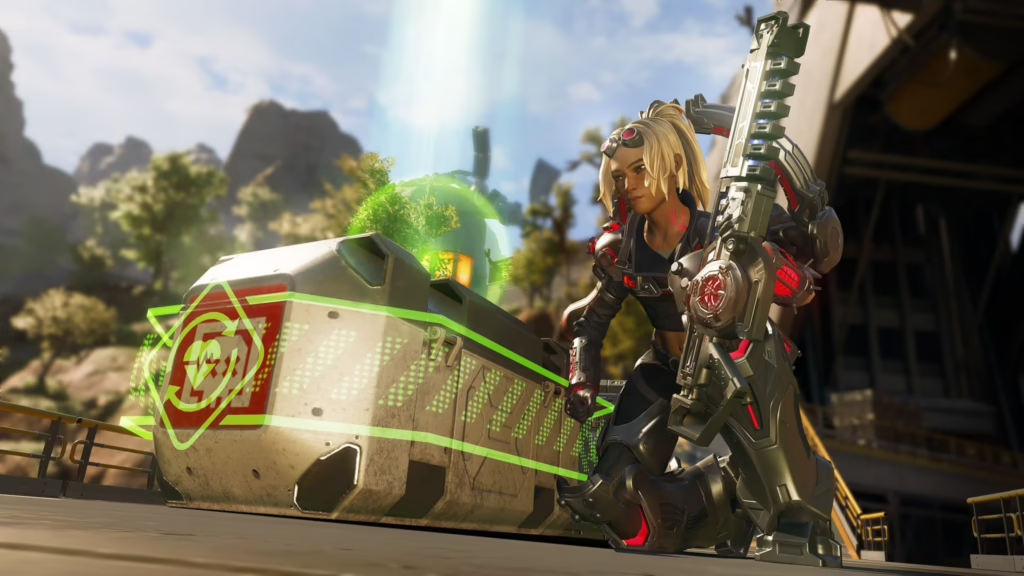
By the way, Apex Legends is currently on its 29th season. Titled “Overclocked,” it brought a bunch of changes across the board, as well as introducing a new Skirmisher legend called “Axle,” focused on high mobility and enemy pushback.
Final Thoughts
The Apex Legends ranking system is designed to be a sophisticated reflection of competitive skill, emphasizing that being the last team standing is the ultimate goal of the Battle Royale. By combining a tiered hierarchy with increasing entry costs and rewarding high-risk tactical plays, the system ensures that only the most consistent and versatile players reach the highest echelons.
For the dedicated player, understanding the interplay between placement points and elimination bonuses is the key to navigating the seasonal splits and eventually claiming a spot among the elite Predators.
Apex Legends is available as a free-to-play download, with in-game microtransactions, on PC, PlayStation 4, PlayStation 5, Xbox One, Xbox Series X|S, Nintendo Switch, and Nintendo Switch 2. However, the Nintendo Switch version of the game is shutting down in August 2026.