
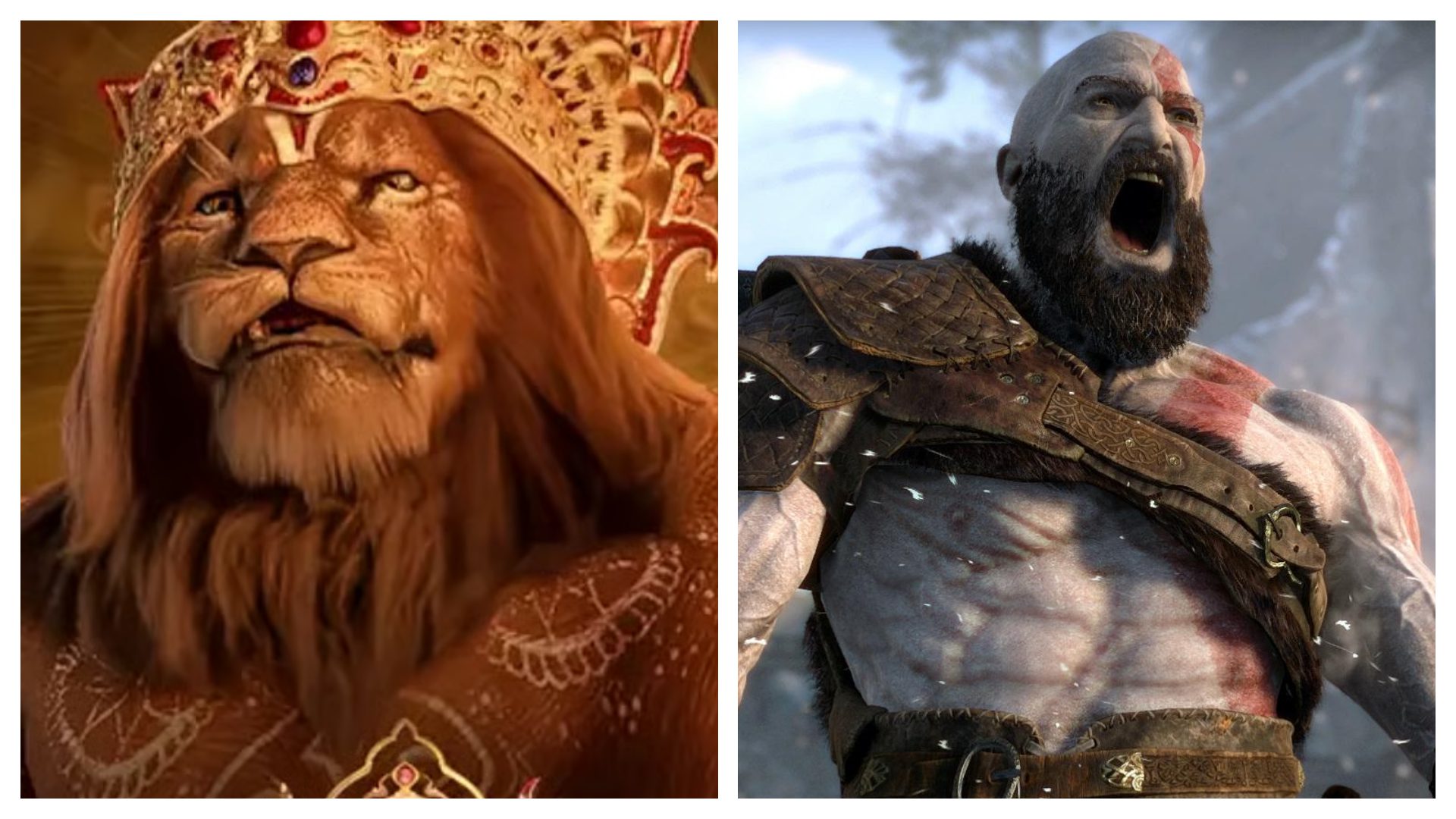
Two deities are putting hands on each other in a senseless beatdown, breaking pretty much everything in the environment around them in a furious, hi-adrenalin battle that tests, at the same time, their values and their strengths. Sound like 2018’s God of War?
Well, kinda, but not quite.
We’re actually talking about Mahavatar Narasimha, a 2024 action movie from India that is quite readily available as one of Netflix’s main offers within the country. And the reason we’re mentioning it alongside PlayStation’s eponymous exclusive is…well, the movie kinda copies God of War — specifically, it emulates Kratos and Baldur’s fight in almost frame-by-frame fashion.
I stumbled upon this while doomscrolling on BlueSky, where I saw a post from Brazil’s CriticalHits and, as I read and dug info about it, managed to find the first mention of this case on Black Thunder’s profile on X. Conveniently, the shot-by-shot comparison video is still up and…well, you can see it for yourself:
In God of War (2018), after killing the entirety of his peers, the former Greek war deity Kratos is now living a secluded life in Midgard, where he inadvertently attracts the attention of the Norse mythology pantheon — specifically, Baldur, the invulnerable, unkillable son of Odin. Shenanigans ensue and, for the sake of not bringing spoilers, let’s just say Kratos and his son Atreus are now in everybody’s crosshairs.
The game had another very successful follow up — God of War Ragnarok — where Kratos faces off with Odin himself (after an incredibly exciting fight against Thor).
Meanwhile, Mahavatar Narasimha tells the stories of two avatars of Vishnu, called Varaha and Narasimha (Vishnu is the supreme being of Vaishavism, one of the most traditional philosophies under the Hinduism faith). Wikipedia’s plot synopsis sorta goes everywhere, making it hard to understand but, essentially, a demon with godlike powers called Hiranyakashipu is oppressing Vishnu’s followers, trying to stop them from following their faith. Then Vishnu appears as Narsimha, a half-lion humanoid that puts his dukes up and the fight you saw above takes place. It’s an analogy to faith triumphing over tyranny, basically.
Now, neither Sony, Netflix, nor Kleem Productions (the company that made Mahavatar Narasimha) have come out with any official commentary as of this writing, but come on, now…is it really needed?
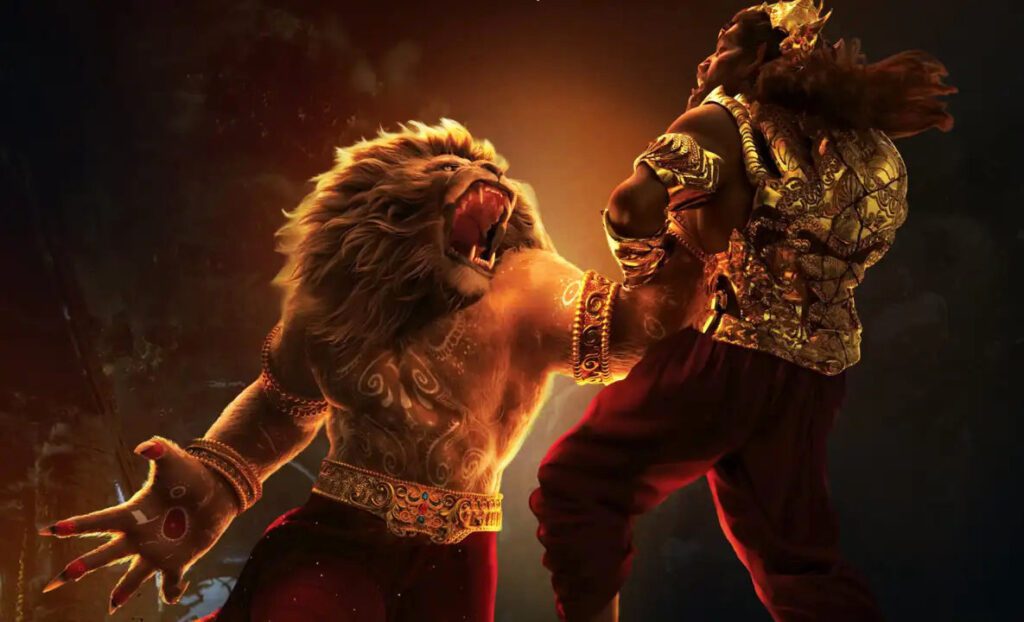
Even funnier is the fact that, copied fight notwithstanding, Mahavatar Narasimha does look like a cool movie. The Indian film industry as a whole has demonstrated resilient growth since at least the early 2010s, expanding from around INR 90-100 billion (around teh $ 1 billion ballpark) in the early part of the decade to INR 187 billion ($2,057 billion) in 2024, despite a pandemic-induced dip in 2020-2021 where revenues halved before rebounding strongly with a 91% increase in 2022, according to data from the Federation of Indian Chambers of Commerce and Industry (FICCI) in partnership with Ernst & Young (EY).
More growth implies more money, which implies more training, better capable professionals, better effects, writing…you get the idea. There’s a reason why Indian movies are getting attention outside of India’s borders. Some of their stuff is truly entertaining. So…why copy something so obvious to see? It’s not like they imitated a small, barely-seen game: this is God of War. In fact, its the God of War that brought the franchise back from a large hiatus with a major bang. This had to be picked up at some point.
Numbers aside, Mahavatar Narasimha just looks good — almost good to the point of not needing to copy God of War in the least. It’s sad to see production companies taking shortcuts such as these, but it is also weirdly funny to see it happen.